
- Decide Whether the Capacity Need Is Actually Temporary
- Rule Out Problems That More Workers Will Not Fix
- Build the Requirement Around the Production Curve
- Convert the Production Gap into a Recruitment Requirement
- Decide Which Roles and Labor Sources Fit the Plan
- Approve the Operating and Compliance Model
- Three Questions Before Approval
- FAQs
A factory receives an order that will lift production for six months. Demand Planning calculates that the plant needs another 200 workers. Adding permanent positions could leave it with excess capacity when the order ends, so temporary labor appears to be the practical choice.
For the Plant Manager, that conclusion comes too quickly.
Before approving a temporary headcount, the plant needs to know whether the additional work is truly temporary, which lines and shifts require support, and whether new workers can become productive before the demand disappears. It must also determine whether the arrangement can meet Vietnamese requirements, corporate employment policies and customer audit standards.
Temporary labor is appropriate when the capacity requirement is time-bound, variable or still uncertain, and when the work can absorb the training and replacement cycle involved. It is not simply a permanent headcount with a shorter approval process.
- Temporary staffing should be driven by a clearly defined production need, not simply a shortage of permanent headcount.
- Confirm that additional workers will solve the capacity constraint and not underlying productivity or process issues.
- Build workforce plans around production demand, including ramp-up, peak, review, and exit stages.
- Recruitment targets should account for no-shows, training completion, absenteeism, and early turnover.
- Match temporary labor to suitable roles, while preserving experienced employees in critical, technical, or safety-sensitive positions.
- Evaluate labor sources based on speed, worker readiness, workforce stability, and total operating cost.
- Define compliance responsibilities, workforce governance, and exit plans before deploying temporary workers.
Decide Whether the Capacity Need Is Actually Temporary
A temporary workforce plan should begin with the production requirement, not the employment model.
The additional capacity may result from a seasonal peak, a short-term customer order, a temporary second shift or a production program whose future volume remains uncertain.
The ManpowerGroup 2025 report shows that employers across Asia Pacific and the Middle East are already adopting more flexible approaches. For seasonal or surge support, 32% were using temporary or contract workers and another 21% planned to do so. The same proportions applied to specialized short-term assignments.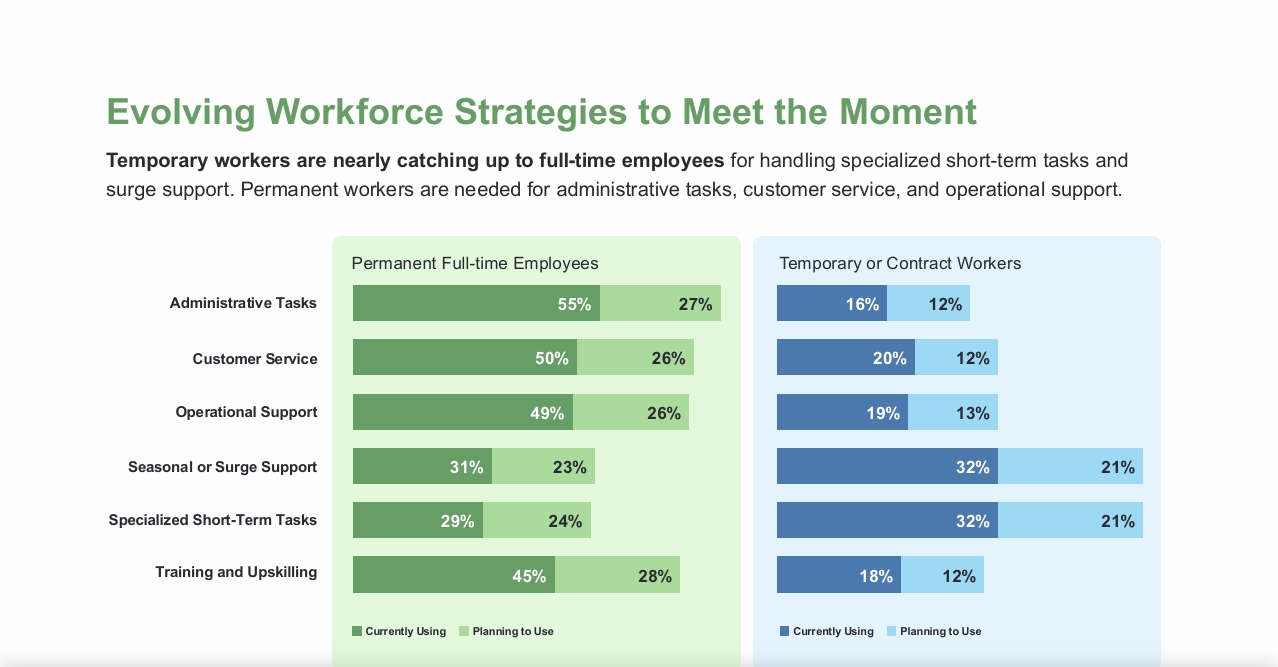
The finding does not mean that temporary staffing fits every production increase. It shows that employers are using it as planned capacity for a particular purpose, rather than only as emergency cover.
In each case, management should be able to identify 3 things:
- The event that creates the demand;
- The period during which capacity is required;
- The decision that will end, reduce or extend the requirement.
A useful test is to complete this sentence: We need temporary workers on these lines, for this production requirement, from this date until this decision point.
If the work continues after the immediate order, the factory may be postponing a permanent workforce decision rather than solving a temporary need.
Temporary labor can also be considered when the local labor market cannot supply the permanent headcount required under the original workforce plan. Management should first identify which production commitments must be protected, then assess whether adjustments are needed to hiring timelines, role requirements, or the workforce mix. These decisions should be made in the context of broader factory labor supply challenges in Vietnam to help maintain production continuity when workers are scarce.

Rule Out Problems That More Workers Will Not Fix
Not every production shortfall is a labor shortage. If downtime, poor line balancing, avoidable rework, or inconsistent work methods are reducing output, adding temporary workers may increase labor cost without removing the constraint. The Plant Manager should establish whether the line lacks people or whether existing labor time is being lost elsewhere.
Temporary labor may also be unsuitable when a role involves lengthy training, scarce technical knowledge or significant safety and quality exposure. If an employee requires most of the assignment to reach the expected level, the plant may not recover its training and supervision of investment.
The same issue arises when supervisors are already stretched. A large intake can reduce the time experienced employees spend on their normal work. More people enter the factory, but effective production capacity may improve slowly or even decline during the opening weeks.
Temporary labor should therefore solve a capacity gap that additional workers can realistically close. It should not conceal a productivity problem or an unresolved need for permanent capability.

Build the Requirement Around the Production Curve
Factories often issue one number to HR or a staffing provider: supply 200 workers.
Production demand rarely moves in such a straight line. The plant may need 50 people while materials are prepared and the first group completes training. Demand may rise to 120 when the second shift starts, reach 200 during peak production and then decline as the order is completed.
A workable temporary workforce plan should identify five points:
- Start date: When must the first workers be ready?
- Ramp-in: How quickly can each line receive and train them?
- Peak: What is the highest temporary capacity required?
- Review point: When will orders, output and labor availability be reassessed?
- Ramp-down, conversion or exit: What happens when the requirement changes?
This production curve gives Operations, HR and the staffing provider one plan. It also avoids recruiting the full peak requirement before trainers, safety sessions, transport or prepared workstations can support it.
If the total requirement has not yet been calculated by production stage, role and shift, management should first use a factory workforce demand estimation framework.

Convert the Production Gap into a Recruitment Requirement
The number of workers requested is not the same as the productive capacity that reaches the line.
Some candidates may accept an offer but not report on their first day. Others may leave during the opening weeks, fail to complete training, or take longer than expected to work independently. Absence will further affect the number available on each shift.
The plan should therefore distinguish among:
- Workers required in production;
- Workers expected to complete training;
- Workers likely to report and remain;
- Candidates who must enter the hiring process;
- Replacements required to keep capacity stable.
No standard percentage should be applied to every factory. Historical data on first-day attendance, training completion, early turnover and absence offer the best starting point. Where reliable data is unavailable, assumptions should be recorded and reviewed after each intake.
The staffing plan should also define how quickly lost capacity must be replaced. A supplier delivering 200 workers once has not solved the requirement if departures leave the plant below its operating target two weeks later.
Factories with significant early attrition can use a replacement-rate and probation drop-off calculation to estimate the candidate's flow required to maintain productive capacity.

Decide Which Roles and Labor Sources Fit the Plan
Temporary workers should not automatically be assigned to areas with the largest vacancies.
For each role, the Factory Manager should consider training time, supervisor demand, replacement difficulty, and the consequences of inexperience. Standardized work with clear instructions may be easier to support through temporary staffing. Roles carrying critical process knowledge or material quality and safety risk may require a stable core of experienced employees.
On a new or sensitive line, experienced internal operators can lead to initial production and serve as trainers. Temporary employees can enter controlled groups as the process stabilizes.
These decisions may change as automation alters job content and increases demand for technical capabilities. The Global Manufacturing World of Work Outlook 2026 examines how automation, skilled-talent shortages and supply-chain change are reshaping manufacturing workforce requirements.
The plant should then compare internal recruitment, referrals, vocational schools, provincial sourcing and staffing providers against 4 operating tests:
- Time to supply;
- Worker readiness;
- Stability over the required period;
- Full operating cost.
A faster external source may carry a management fee but offer wider reach and replacement capacity. A slower channel may produce greater stability. When training is expensive, lower turnover may matter more than the lowest initial recruitment cost.
There is no universal internal-to-outsourced ratio. The appropriate balance depends on market availability, internal recruitment capacity and the cost of leaving production short.

Approve the Operating and Compliance Model
For a multinational manufacturer, compliance is part of workforce design, not a review conducted after workers arrive.
Before sourcing begins, the factory and its workforce provider should establish who is responsible for employment documentation, payroll, insurance, working-time controls, safety preparation and worker records. They should also identify the evidence required by corporate policy, internal audit, customers, and social compliance programs.
Daily responsibilities need the same clarity. The plant should know who records attendance, communicates workplace rules, handles employee issues and initiates replacements.
For large manufacturers, the workforce model is only as reliable as the process used to recruit, employ, deploy and govern it.
Finally, management must define what happens at the end of the requirement. Capacity may decline in stages, assignments may end, or selected roles may be reviewed for a longer-term arrangement.
A plan with a start date but no exit decision is not yet a temporary workforce plan.
Three Questions Before Approval
Temporary labor can help a plant respond to changing demand without turning every production increase into a permanent headcount commitment. But flexibility comes from the design of the plan, not the employment label.
Before approving temporary labor, the Plant Manager should be able to answer three questions:
- Why is this requirement temporary?
- How much productive capacity is needed, and when?
- How will the workforce enter, operate and leave under the standards the business must meet?
If those answers are clear, temporary staffing can become a planned production capacity. If they are not, a headcount order is being issued before the operating decision has been made.
Planning temporary capacity for a factory in Vietnam?
Explore how local labor-market insight, compliant staffing and workforce administration can help translate changing production demand into a workable plan.
Find out Workforce Scaling Solutions in Vietnam
FAQs
Temporary workers are most suitable when production demand is time-bound, seasonal, uncertain, or linked to a specific project. They should be used to address temporary capacity needs rather than replace long-term workforce planning.
Management should identify the event creating demand, the expected duration of the requirement, and the decision point that will reduce, extend, or end the need for additional workers.
No. If production issues stem from downtime, poor line balancing, rework, inadequate supervision, or process inefficiencies, adding temporary workers may increase labor costs without improving output.
The plan should follow the production curve, including ramp-up, peak demand, review points, and ramp-down stages. This helps ensure worker supply matches operational requirements throughout the project lifecycle.
Not all hired candidates become productive employees. Factors such as no-shows, training drop-offs, absenteeism, and early turnover mean factories often need a larger recruitment pipeline than the final workforce requirement.
Roles with standardized processes, shorter training requirements, and lower operational risk are generally easier to support with temporary workers, while highly technical or safety-critical positions often benefit from experienced permanent staff.
Key considerations include speed of supply, worker readiness, workforce stability, replacement capability, and total operating cost across recruitment, training, and retention.
Factories should clarify responsibilities for employment documentation, payroll, insurance, attendance management, safety requirements, and workforce governance before deployment to ensure compliance with legal, customer, and corporate standards.