A plant misses production targets. Management's first reaction is often the same: hiring more people.
Sometimes that is the right decision. Often it is not.
A factory launching a new production line, replacing retiring technicians, preparing automation, and managing seasonal demand may all report the same problem: a talent gap. Yet the right workforce response could be completely different in each situation.
This is why many workforce plans have become expensive. Companies choose a solution before they diagnose the problem.
Manpower’s Global Manufacturing World of Work Outlook 2026 reveals a pressing dual threat: 72% of manufacturers struggle to secure skilled talent, while 93% expect smart technology to redefine workforce requirements. Finding talent is tough; building the right workforce response is tougher.
- Not every workforce gap requires more hiring. The right solution depends on the business constraint behind the shortage.
- The same talent gap may call for building, buying, borrowing, or bridging talent based on duration, risk, and talent availability.
- Manufacturers should diagnose workforce needs before committing budget, headcount, or recruitment campaigns.
- Successful workforce strategies align talent capacity with business goals, not hiring targets alone.
The Same Talent Gap Can Hide Different Problems
Imagine 4 manufacturing businesses.
- The first is opening a new production line next year.
- The second has lost several experienced maintenance specialists.
- The third expects demand to spike for six months.
- The fourth is introducing new automation equipment.
All four report a workforce shortage. Yet only one of them may actually need large-scale recruitment. The others may need training, redeployment, temporary workforce support, or a different mix of skills entirely.
This is where many workforce discussions go wrong. They start with headcounts. They should start with the constraint: What is stopping the business from reaching its production, quality, or expansion target?
The answer matters because the solution depends on the problem.

Before Choosing a Workforce Solution, Diagnose the Gap
The Build-Buy-Borrow-Bridge model works best when it starts with four simple questions.
How long will the capability be needed?
A capability required for several years deserves a different response than one needed for a short-term project.
How much risk does the gap create?
A missing technician and a missing production supervisor may have very different business consequences.
Can the capability realistically be hired by the market?
The existence of talent somewhere in Vietnam does not mean the talent is accessible where and when it is needed.
Could someone already on payroll reach the required skill level fast enough?
This is often the most neglected question. Many organizations search outside before understanding what already exists inside.
Once these questions are answered, the workforce decision becomes clearer.
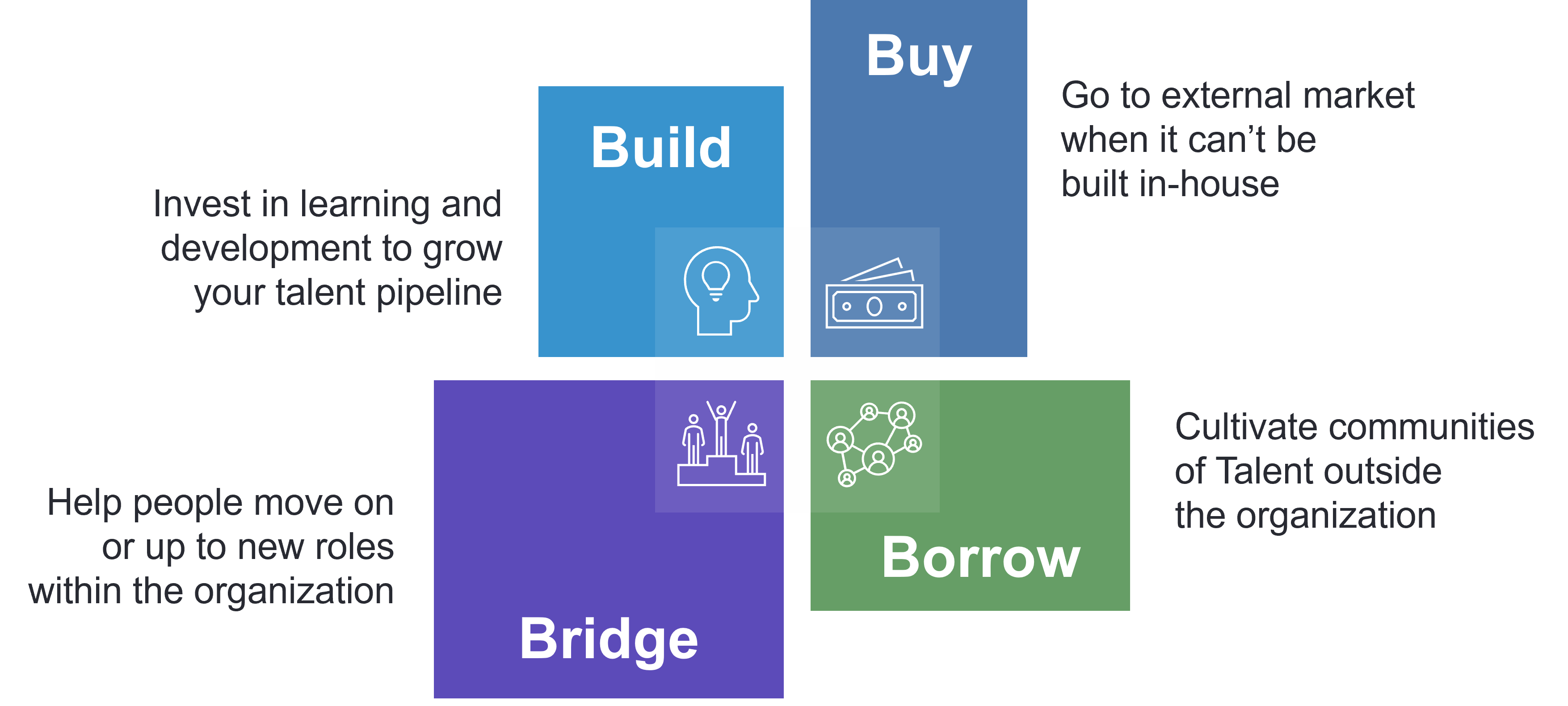
Build, Buy, Borrow, or Bridge?
The value of Build-Buy-Borrow-Bridge comes from understanding when each option becomes the least risky decision.
Build
Build is appropriate when a capability will be needed for years and cannot be replaced easily.
Examples include automation capability, engineering expertise, quality leadership, and technical supervision.
Building capability takes time, but it creates resilience.
For manufacturers planning future workforce requirements, Automotive Workforce Planning in Vietnam Beyond Headcount Growth explores how capability demand changes before shortages become visible.
Buy
Buy is appropriate when talent exists in the market, and business timelines require faster action. This is common during plant expansion, leadership hiring, and specialist recruitment.
The biggest mistake is assuming that available candidates automatically mean available capability.
The two are rarely identical.
Borrow
Borrow is appropriate when business requirements move faster than workforce certainty. Production volumes change. Project timelines move. Market conditions are shifting.
Temporary staffing and outsourced workforce solutions help employers add capacity without committing to permanent headcounts too early.
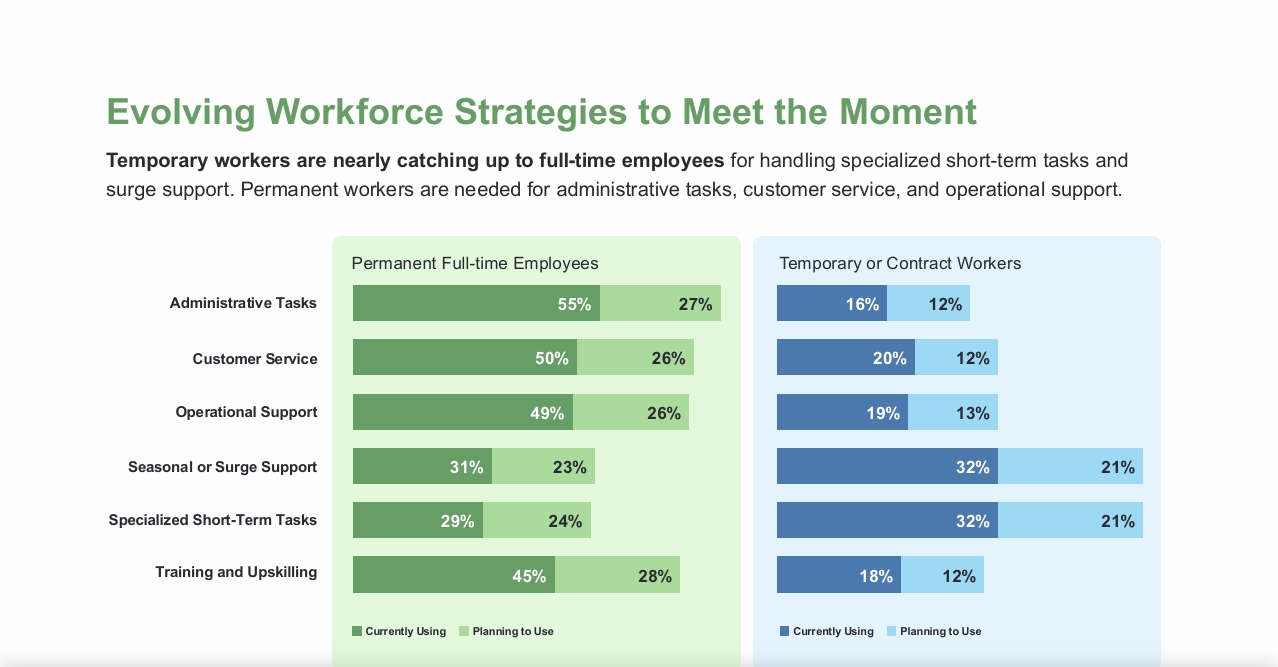
This is one reason why recruitment volume alone does not determine workforce readiness. 5 Mass Hiring Mistakes Manufacturing Employers Make explores this challenge in more detail.
Bridge
Bridge is appropriate when the capability already exists inside the organization.
Cross-training, internal mobility, and accelerated development can sometimes create capacity faster than external hiring.
In a tight labor market, skills already on payroll are often underestimated.

Why Workforce Decisions Fail After Selection?
Many workforce strategies fail for a simple reason: The decision was correct, but the ownership was not.
After choosing Build, Buy, Borrow, or Bridge, manufacturing leaders still need clear answers to several practical questions:
- Who owns replacements when turnover happens?
- How often is workforce performance reviewed?
- What triggers corrective action?
- Who decides when assumptions are no longer valid?
- Which metrics indicate increasing workforce risk?
These questions rarely appear in workforce planning discussions, yet they often determine whether a workforce strategy succeeds.

A Manufacturing Expansion Example
One industrial technology manufacturer expanding operations in Vietnam faced a challenge familiar to many fast-growing manufacturers.
The company did not simply need more hires. It needed workforce capacity to arrive in stages as expansion milestones were reached.
Different hiring waves had to align with production plans. Workforce visibility had to be maintained across multiple functions. Hiring managers needed real-time information to adjust plans as business requirements evolved.
A dedicated delivery team, phased workforce planning, and ongoing reviews allowed workforce growth to stay aligned with operational targets rather than recruitment targets alone. The focus was not how many positions were filled. The focus was on whether capacity arrived at the right time.
That distinction is easy to miss. It is also where many workforce strategies succeed or fail.
For a detailed example of how workforce capacity was planned across multiple expansion phases, see our case study on scaling workforce capacity for a manufacturing expansion in Vietnam.
Closing Thought
Most workforce discussions begin with the wrong question.
“How many people do we need?”
A better question is:
“What problem are we actually trying to solve?”
Only after answering that question do Build, Buy, Borrow, or Bridge become useful.
A workforce gap is not automatically a hiring problem. Until the constraint is understood, choosing a workforce solution is largely guesswork.
For manufacturing employers operating in Vietnam, the quality of that diagnosis often matters more than the size of the recruitment campaign.
The most expensive workforce decision is often not the wrong hire. It is solving the wrong problem. Before committing additional budget, headcount, or workforce programs, manufacturing leaders should first establish what constraint is actually limiting capacity and whether it should be built, bought, borrowed, or bridged. That is typically where the first discussion with Manpower Vietnam begins.
Contact us to discuss your plan now