
- What do payroll companies for small businesses do?
- What payroll solutions for small businesses are available today?
- Payroll software vs payroll outsourcing
- When should small businesses outsource payroll services?
- How to choose the best payroll company for small business
- Why consider Manpower Vietnam for payroll outsourcing
Choosing the right payroll company for small businesses can help simplify salary administration while creating a smoother experience for employees. This guide helps make that decision easier by outlining the key factors to consider when choosing payroll services.
- Payroll providers do more than just process salaries.
- The right payroll solution depends on your business complexity and internal capacity.
- Choosing the right provider is about long-term value, not just cost.
What do payroll companies for small businesses do?
Payroll processing and salary calculation
One of the primary responsibilities of a payroll provider is ensuring employees receive the correct pay every payroll cycle. This includes calculating salaries based on contracts, attendance, overtime, bonuses, allowances, and deductions.
Payroll tax filing and compliance support
A reliable payroll outsourcing provider does more than calculate taxes. It also helps ensure filings are accurate, on time, and compliant with current laws. In markets like Vietnam, where compliance requirements can be complex, having a trusted partner minimizes legal risks and penalties.
Employee records and payroll reports
Payroll is also a data-driven function. Every salary, deduction, and contribution needs to be recorded clearly. Payroll companies maintain structured employee records and generate detailed reports that support financial planning, audits, and internal decision-making.
For employees, access to accurate pay slips and tax documents increases transparency. In fact: Nearly 80% of employees prefer greater pay transparency, including clear explanations of how salaries are calculated (Heisler 2026)
This growing expectation reflects a broader shift in how employees engage with compensation.
To learn how payroll can support your wider business goals, explore the key benefits of payroll services.
What payroll solutions for small businesses are available today?
Payroll software
At the most basic level, businesses can rely on payroll software to automate calculations and reporting. These systems reduce manual work and improve consistency, but they still require internal teams to manage payroll operations.
Full-Service payroll outsourcing
With full-service payroll outsourcing, the dynamic shifts significantly. Instead of managing payroll internally, businesses rely on a provider to handle the entire process, from salary calculations to statutory filings and reporting.
Payroll and HR outsourcing providers
Some organizations go even further by partnering with payroll and HR outsourcing providers. Some providers go beyond payroll and also support recruitment, attendance, labor contracts, and compliance.
This integrated approach allows businesses to outsource the entire employee lifecycle, creating a more cohesive and scalable HR operation.
Payroll software vs payroll outsourcing
With different payroll solutions available, businesses need to understand the difference between using payroll software and outsourcing payroll.
| Factor | Payroll Software | Payroll Outsourcing |
|---|---|---|
| Cost |
Lower direct cost (subscription-based), but requires internal time, training, and payroll expertise. |
Higher service fees but can reduce internal HR costs by 35% on average. |
| Control |
Full control over payroll data, processes, and adjustments with real-time access. |
Control is shared with the provider, reducing internal workload but limiting direct oversight. |
| Compliance |
Responsibility remains in-house; requires continuous updates to stay compliant with tax and labor laws. |
Managed by payroll specialists who monitor regulations and handle filings, reducing compliance risks. |
| Support |
Typically limited to system support or helpdesk guidance; execution remains internal. |
End-to-end support from dedicated experts who manage payroll operations and resolve issues proactively. |
For small businesses, this is often just one part of the decision. Looking more closely at how in-house payroll compares with outsourced support can provide useful context when choosing the right long-term setup. Ultimately, the right choice comes down to whether your business prefers to stay in control or hand more responsibility to a provider.
When should small businesses outsource payroll services?
As businesses grow, payroll can become more complex, which may be a sign that it is time to outsource. Common signs include:
- Payroll takes too much time from HR or finance
- Payroll errors happen frequently
- The business is growing headcount quickly
- The company has complex overtime, leave, or allowance rules
- The business needs stronger tax and compliance support
- The company wants to improve employee payroll experience
How to choose the best payroll company for small business
Choosing a payroll provider is not just about cost. It is about finding a partner that fits your business needs, compliance requirements, and growth plans. To make the right decision, businesses should evaluate several key factors.
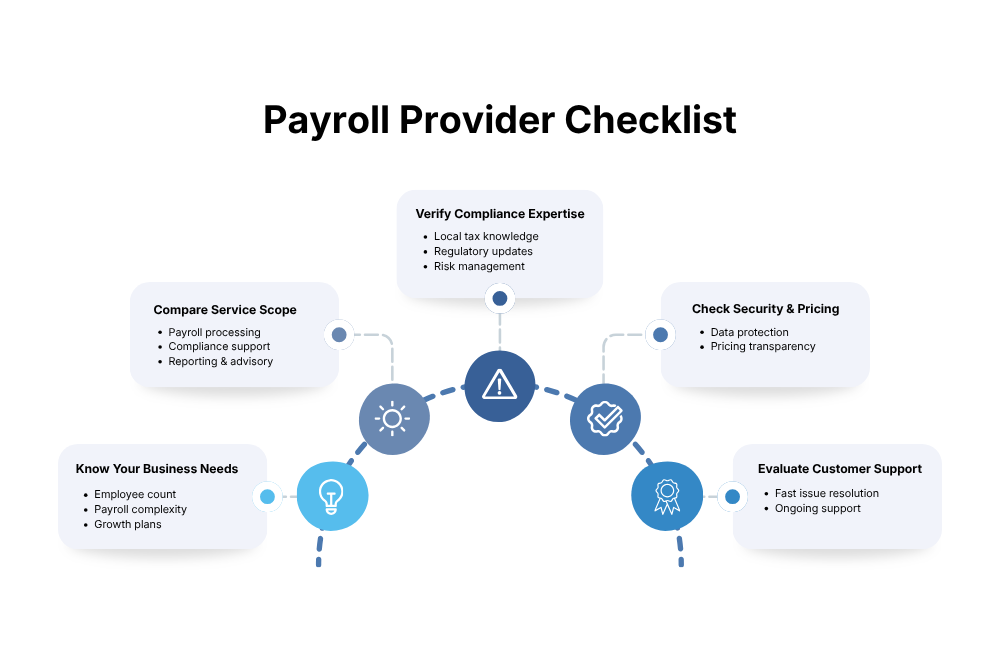
Define your payroll needs and business size
The first step is understanding your own complexity. A startup with fewer than 20 employees will have very different payroll needs from fast-growing companies. Factors such as employee count, pay structures, and growth plans should guide your decision.
Check the provider’s payroll service scope
Not all providers offer the same level of service. Some focus purely on processing, while others include compliance, reporting, and advisory support. A broader scope often delivers greater long-term value.
Evaluate tax and compliance expertise
Compliance is one of the most critical selection criteria. A provider with solid payroll compliance knowledge can help your business follow local regulations and avoid penalties.
Ensure data privacy and pricing transparency
Payroll involves highly sensitive information, so strong encryption, access controls, and clear data policies are essential.
At the same time, pricing transparency is equally important. Providers should clearly outline their service fees, setup costs, and any additional charges for reporting or scaling. Hidden costs can quickly reduce the value of an otherwise strong solution.
Review customer support and payroll operations model
Finally, consider the level of support provided. A dedicated payroll team or account manager can help resolve issues quickly and keep payroll operations running smoothly.

Why consider Manpower Vietnam for payroll outsourcing
By combining payroll expertise with integrated HR technology, Manpower Vietnam helps businesses manage their workforce through a single, connected solution.
End-to-end payroll outsourcing with integrated HR support
Unlike standalone payroll providers, Manpower combines payroll with broader workforce solutions such as onboarding, attendance tracking, and employee data management. This creates a more seamless HR experience.
Employee self-service for improved experience and efficiency
Beyond supporting businesses, employees can also manage routine payroll-related tasks without relying on HR for every request. This includes:
- View pay slips and personal data
- Submit leave and overtime requests
- Track attendance and working hours
Flexible payroll engine for complex payroll structures
No two businesses manage payroll the same way. That's why the platform can be customized to match your salary structures, overtime rules, allowances, and internal policies.
Secure payroll data management
Staying compliant and protecting employee data are both essential parts of effective payroll management. Manpower Vietnam supports PIT, SHUI, and reporting requirements while aligning with global standards such as ISO 27001 and GDPR, helping businesses manage payroll with greater security and accuracy.
Conclusion
For small businesses, choosing a payroll provider is about more than finding the lowest cost. The right partner can help streamline payroll, support compliance, reduce administrative work, and create a better experience for employees. Ultimately, the best solution depends on your business needs, available resources, and long-term goals.
Reference List
Heisler W. (2026). Pay Transparency: How Much Disclosure Do Employees Want?. View source
World Metrics (2024). HR Payroll Industry Statistics. View source

.jpg)