
A manufacturer in Vietnam calculates that it needs 500 additional workers to meet a new production plan. Local market evidence suggests that only 300 suitable workers can be recruited and deployed within the required period.
But the real impact is felt across operations: overtime, incomplete shifts, delayed training, supervisors moved between production lines, and output falling below plan. These pressures can quickly put manufacturing workforce continuity at risk.
At this point, another round of job advertising may generate more recruitment activity without increasing the actual labor supply available to the factory.
Management therefore has a different decision to make:
When labor is scarce, spreading the shortage evenly can leave every line inadequately staffed. Production continuity may depend on concentrating available workforce capacity where it protects the greatest business and operating value.
- Validate labor shortages using local market data before changing production plans.
- Prioritize critical production lines, customer orders, and key roles instead of spreading shortages evenly.
- Match workforce strategies to the specific gap through training, temporary staffing, transport support, or phased ramp-ups.
- Labor shortages increase hidden costs such as overtime, delayed output, and supervisory workload.
- Set clear triggers for when workforce constraints require production plan adjustments.
- Production plans should reflect realistic labor availability, not hiring targets.
Confirm That the Shortfall Is Real
Before changing the production plan, test whether the labor constraint reflects current local evidence.
Review:
- Suitable workers within a practical commuting radius;
- Vailability by role and shift;
- Competing factories;
- Wage, allowances and expected take-home pay;
- Transport options;
- Trainable versus scarce skills;
- Sustainable candidate flow by week;
- Recruitment and deployment lead time;
- Seasonal patterns, including Tet.
Vietnam’s labor market is not one national pool. Supply around an electronics factory in a northern industrial hub may differ from supply around a southern garment, logistics or consumer-goods operation.
After Tet in 2025, manufacturers in several industrial areas reported difficulty rebuilding workforces as some workers extended family time, returned later or sought jobs closer to home. Transport and living costs also affected those decisions. These observations should be tested against the factory’s own location and workforce data. Read Manpower Vietnam’s post-Tet labor-market analysis.
Mass Recruitment Checklist for Manufacturing Companies in Vietnam provides a fuller test of local supply, workforce model and factory readiness.

Rank the Production Capacity the Workforce Must Protect
Once the shortage is confirmed, do not begin by dividing the available workers evenly.
Rank the production capacity the workforce would protect:
- Customer-delivery commitments;
- Safety and quality controls;
- Strategic or high-priority orders;
- Equipment that would otherwise remain underused;
- Roles carrying scarce process knowledge;
- Capabilities that take the longest to restore;
- Cost created while the capacity remains unavailable.
A factory may be better served by fully staffing one priority line than leaving two lines below stable operating coverage. A lower-priority launch may need to begin later. Experienced workers may need to remain around a critical process rather than being distributed across every planned expansion.
The underlying role and shift requirement should be traceable through How Many Workers Does a Factory Need? A Practical Demand Estimation Framework.

Concentrate Capacity Instead of Spreading the Shortage
Workforce scarcity requires explicit choices.
Management may decide to:
- Protect one customer order before a lower-priority order;
- Open a new line in stages;
- Preserve experienced technical and supervisory capability;
- Move trainable work to candidates with adjacent skills;
- Extend transport to reach a wider labor area;
- Delay work that cannot be staffed safely or consistently.
These are production decisions informed by workforce evidence. They should not be left to Recruitment to resolve through higher application targets.
A role should be redesigned only where Operations and Process Engineering confirm that safety, quality and workload remain acceptable.
The principle is simple:
Select the Response That Fits the Gap
Different shortages require different responses.
A short, defined surge may justify temporary capacity. A shortage of ready-made skills may require training candidates who meet the essential rather than every preferred criterion. A geographic constraint may justify transport support or a wider recruitment radius. A structural gap may require a revised launch date, workforce model or role design.
How to Build a Temporary Workforce Plan for a Factory in Vietnam helps determine where flexible capacity fits.
Where a critical capability needs an independent recovery route, use A Practical Factory Workforce Contingency Plan for Vietnam: Prioritizing Critical Capabilities.
Labor scarcity also creates costs beyond recruitment fees. Overtime, delayed output, repeated training and supervisor intervention accumulate while capacity remains unavailable.
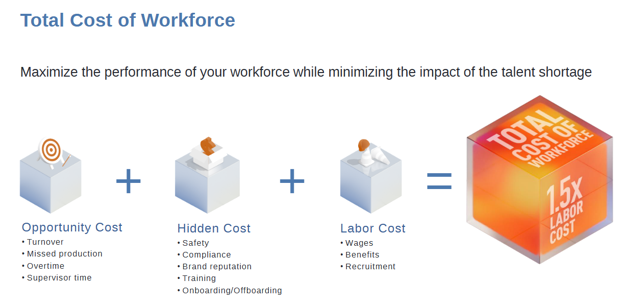
Manpower’s Total Cost of Workforce framework brings together three layers:
- Labor cost: wages, benefits and recruitment
- Hidden cost: safety, compliance, training, onboarding, offboarding and supervisory time
- Opportunity cost: turnover, overtime, missed production and delayed output
Read Factory Workforce Ramp-Up Cost Checklist for Vietnam: What the Labor Budget Misses for the fuller cost review.

Set the Point at Which the Production Plan Must Change
A constrained plan becomes risky when management continues to assume that missing labor will arrive later.
Before execution begins, define the point at which production assumptions must be revised. Triggers may include:
- weekly labor delivery below the validated market assumption;
- recovery lead time exceeding production tolerance;
- critical-role coverage remaining unresolved;
- overtime reaching an approved boundary;
- recurring quality, safety or supervisor pressure;
- worker availability deteriorating by shift or location.
A trigger turns workforce evidence into a management decision. Without one, the factory may spend several weeks waiting for a supply recovery the market cannot support.
Scarcity Should Force Prioritization
The local market may not provide every worker in the original plan, at the required time and in the required place.
When that happens, the answer is not necessarily more recruitment activity. It is a production plan built around the workers the market can supply, the capacity the business must protect and the point at which assumptions must change.
Scarcity does not remove choice. It makes the order of those choices more important.
Does the workforce plan reflect current local labor availability?
Explore Workforce Scaling Solutions in Vietnam when the factory is ready to combine local market evidence with scalable and compliant workforce options.
Scale Your Manufacturing Workforce